Summary
Cerebral is a $4.8B mental health startup focused on accessible, affordable therapy and medication. I led their first comprehensive research initiative to understand how customers experienced the product and what they needed most.
I interviewed active customers, mapped their journeys, and delivered insights that shaped the next two years of product development. The recommendations led to a 26% increase in customer satisfaction and convinced leadership to build an internal research team.
It was with supreme confidence that I tapped Josh to run my initial research program at Cerebral. It had to both serve as a template and convince critical leadership, and as usual he delivered top shelf work.
Background
The challenge
Cerebral had grown rapidly to a $4.8B valuation, but product decisions were being made without systematic customer understanding. Leadership was estimating priorities for the roadmap, and there was no internal research function to validate assumptions.
My role
I was brought in as a consultant to lead Cerebral's first comprehensive research initiative. Working with the Head of Design, I scoped the study, brought in a second researcher to partner with, and managed our team through interviews, synthesis, and final presentations to leadership and cross-functional teams.
Approach
Our team interviewed seven active Cerebral customers who had renewed their subscriptions and recently engaged with clinicians. Starting with stakeholder interviews and customer service data, I identified the most critical questions to explore. The 45-minute sessions used participatory techniques to understand not just what customers did, but why they made those choices.
Key insights
I can't do this alone anymore
Bethany
Wanted to speak to someone, preferably a woman she identified with, because she felt she could no longer handle her situation alone.
Lindsey
Wanted to get access to medication as quickly as possible to treat her already diagnosed condition.
Insight
Cerebral customers are looking for someone to trust.
This vulnerable moment requires empathy and support. Customers arrive with deeply personal goals that go beyond simple healthcare transactions.
Recommendation
Extend a helping hand
Build trust from the first interaction. Show empathetic communication, introduce clinicians personally, and clearly explain how Cerebral can help with individual goals.
Is this really working for me?

Jasmyn
Wanted therapy, but is now getting medication she doesn't REALLY want to be on (though it's working).

Callie
Wanted medication, but is also getting (and paying for) counseling she doesn't REALLY want.
Insight
There is no 'one size fits all'
Customers want control over their treatment. They're open to recommendations but may look elsewhere if forced into services they don't value.
Recommendation
Bespoke treatment plans
Create collaborative planning that lets customers shape their care. Explain service benefits clearly and offer flexible options so customers only pay for what they need.
Finally, someone gets me

Dawn
Wanted to talk to someone who understands her situation -- a fellow mother and person of color.
Tony
Wanted "answers" and to understand experiences he's had his entire life.
Insight
Connection gives customers hope for the future.
When customers connect with the right clinician or receive a diagnosis that explains their experiences, they gain hope. Both empathy and understanding help people accept themselves and envision improvement.
Recommendation
Facilitate a 'sigh of relief'
Train clinicians to deliver personalized, empathetic responses. Create accessible resources that explain diagnoses in relatable terms and highlight paths to improvement.
Results and impact
Research synthesis
I led the synthesis of our findings into a comprehensive journey map documenting customer emotions, actions, touchpoints, and opportunities throughout their Cerebral experience. This became a reference tool for product and design decisions.
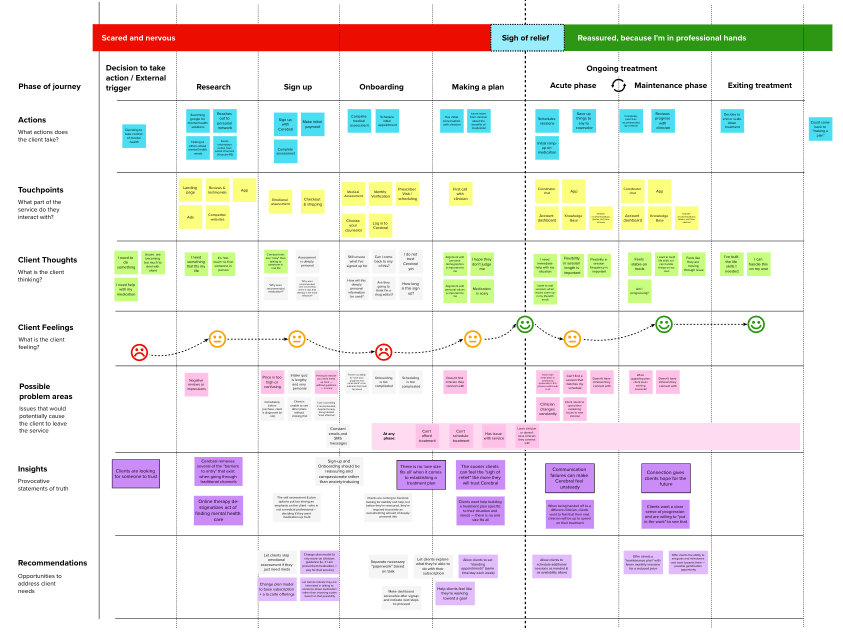
Company-wide influence
The insights directly shaped Cerebral's 2-year product roadmap. Rather than estimating what features to build next, teams across product, design, and customer success could now point to specific customer needs to guide their decisions.
Establishing a research practice
This research convinced leadership to hire Cerebral's first dedicated research team. They recognized that understanding their customers wasn't a one-time project but an ongoing necessity for a company serving vulnerable moments in people's lives.